The K-Shaped Economy
It’s No Longer a Theory
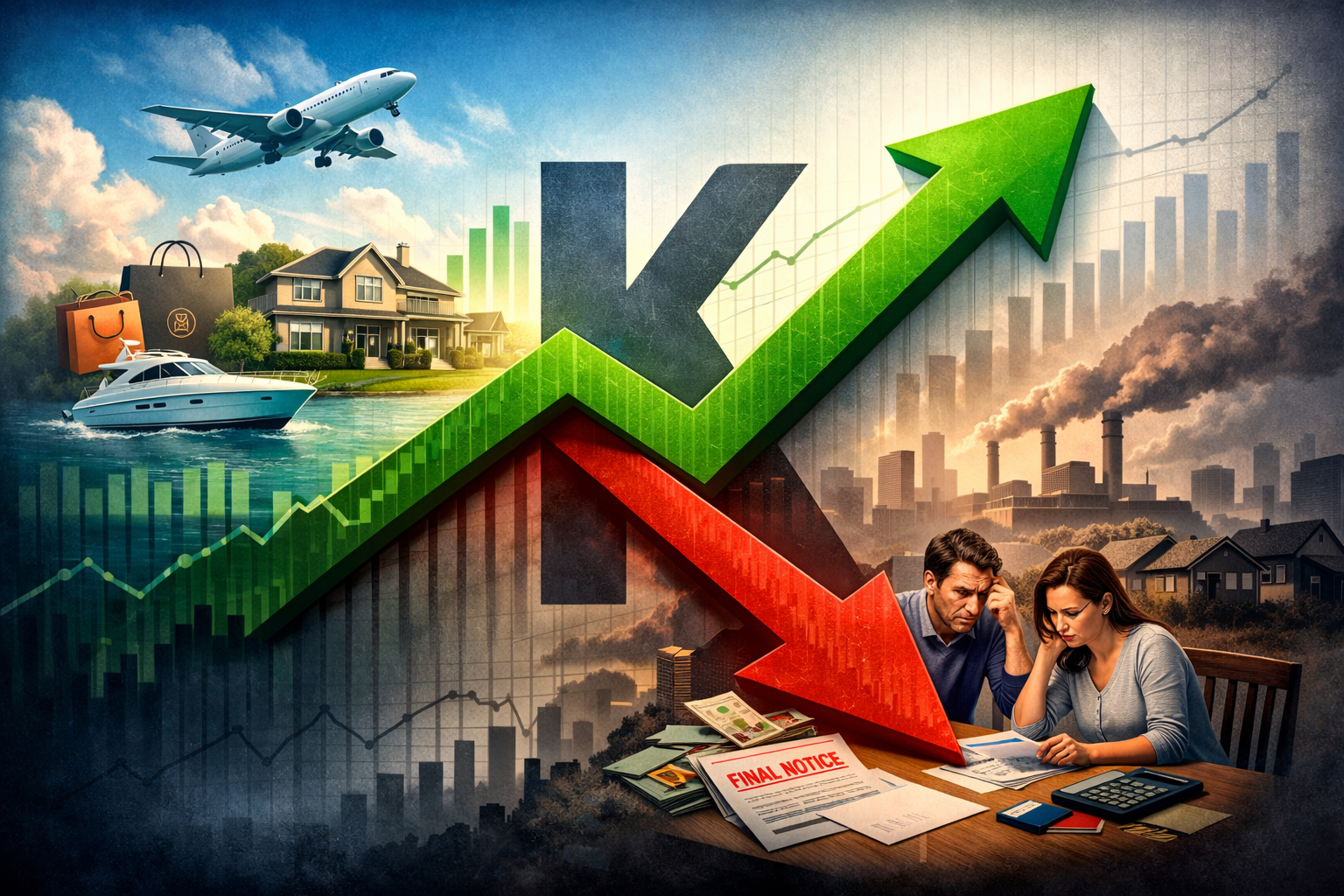
A recent report from CNBC highlights something many families have quietly felt for some time: the American economy is splitting into two very different experiences. Higher-income households continue to spend freely, travel, dine out, and invest. Meanwhile, middle-income families are increasingly leaning on credit cards and struggling to keep up with rising costs. Economists call this a K-shaped economy — where one group moves upward while another moves downward.
That divergence matters far more than a headline suggests.
What the Data Is Showing
The CNBC analysis notes that consumer spending overall has remained resilient. On the surface, that sounds encouraging. But when you look under the hood, the strength is not evenly distributed. Higher earners, whose portfolios and home values surged during the long bull market, are still comfortable. Asset inflation has supported their confidence.
The middle class, however, is telling a different story. Credit card balances remain elevated. Delinquencies are rising in certain income bands. Savings cushions built during stimulus years are thinning. In short, spending is being maintained — but increasingly through debt rather than income growth.
That distinction is critical.
An economy powered by expanding productivity and rising real wages is sustainable. An economy powered by credit expansion while costs remain elevated is far more fragile.
Why This Matters for Investors
Roughly 70% of U.S. GDP is tied to consumer spending. When spending becomes dependent on leverage rather than organic income growth, risk builds quietly beneath the surface. Markets can continue higher for a time, but the foundation weakens.
History shows that late-cycle environments often look deceptively strong. Corporate earnings hold up. Asset prices remain elevated. Confidence surveys appear stable. But underneath, stress begins concentrating in specific segments — housing affordability, consumer credit, commercial real estate, or small business financing.
The K-shape is not just about fairness. It is about stability.
When the middle tier of consumers — historically the backbone of steady economic expansion — begins to strain, growth becomes less durable.
Inflation’s Lingering Impact
Even if headline inflation has cooled from its peak, cumulative price increases over the past several years have permanently altered household budgets. Groceries, insurance, property taxes, healthcare, and utilities remain structurally higher. For retirees and near-retirees living on fixed incomes, these increases are not theoretical — they are monthly realities.
When inflation outpaces real wage growth for an extended period, purchasing power erodes quietly. That erosion rarely shows up immediately in equity valuations, but it eventually surfaces in margins and demand.
Asset Inflation vs. Everyday Inflation
One of the defining features of this cycle has been the divergence between asset owners and wage earners. Financial markets benefited enormously from years of ultra-low rates and liquidity expansion. Those who owned appreciating assets gained wealth. Those dependent primarily on wages experienced higher living costs without proportional wealth expansion.
This dynamic widens the K.
It also increases volatility potential. Markets often price in aggregate numbers — total spending, aggregate earnings — while overlooking the distribution beneath them. Distribution matters more than totals during turning points.
A Fragile Balance
None of this guarantees an imminent downturn. But it does suggest the economy may be more sensitive than headline data implies. When spending becomes concentrated at the top and debt-dependent at the middle, the margin for policy error narrows.
Interest rate decisions, credit conditions, and labor market shifts carry amplified consequences in such an environment.
For investors — especially those in retirement or approaching it — the question is not whether growth continues for another quarter or two. The question is whether portfolios are prepared for a potential rebalancing of this K.
The Discipline of Preparation
Markets do not ring bells at peaks. Economic stress rarely announces itself clearly in advance. It builds in pockets, often hidden in credit data, consumer behavior shifts, or subtle changes in liquidity.
The K-shaped dynamic is one such pocket.
Preparation does not mean panic. It means thoughtful risk assessment, stress-testing allocations, understanding concentration, and ensuring income durability under multiple scenarios.
Periods of divergence often precede periods of adjustment. And adjustment, while uncomfortable, can create significant opportunity for those positioned with discipline and patience.
We are living in historic times — not because headlines are dramatic, but because structural shifts are occurring beneath them.